I have been pulling filters out of furnace cabinets across Central Florida for years, and the small printed arrow on the side of the frame is one of the most consistently overlooked details on residential service calls. Which way an air filter goes in a furnace comes up on almost every call I run, and the answer is more specific than most homeowners realize. The arrow is small, the cabinet is usually dim, and most homeowners were never told that the arrow shows the direction air flows through the system rather than the side the air comes in from. Get the arrow right when checking which way does air filter go in furnace, and your furnace can move air more smoothly and run efficiently for years. Get it wrong, and the blower motor pays for the mistake every cycle until somebody pulls the filter back out and reads the imprint correctly.
TL;DR Quick Answers
Which way does an air filter go in a furnace?
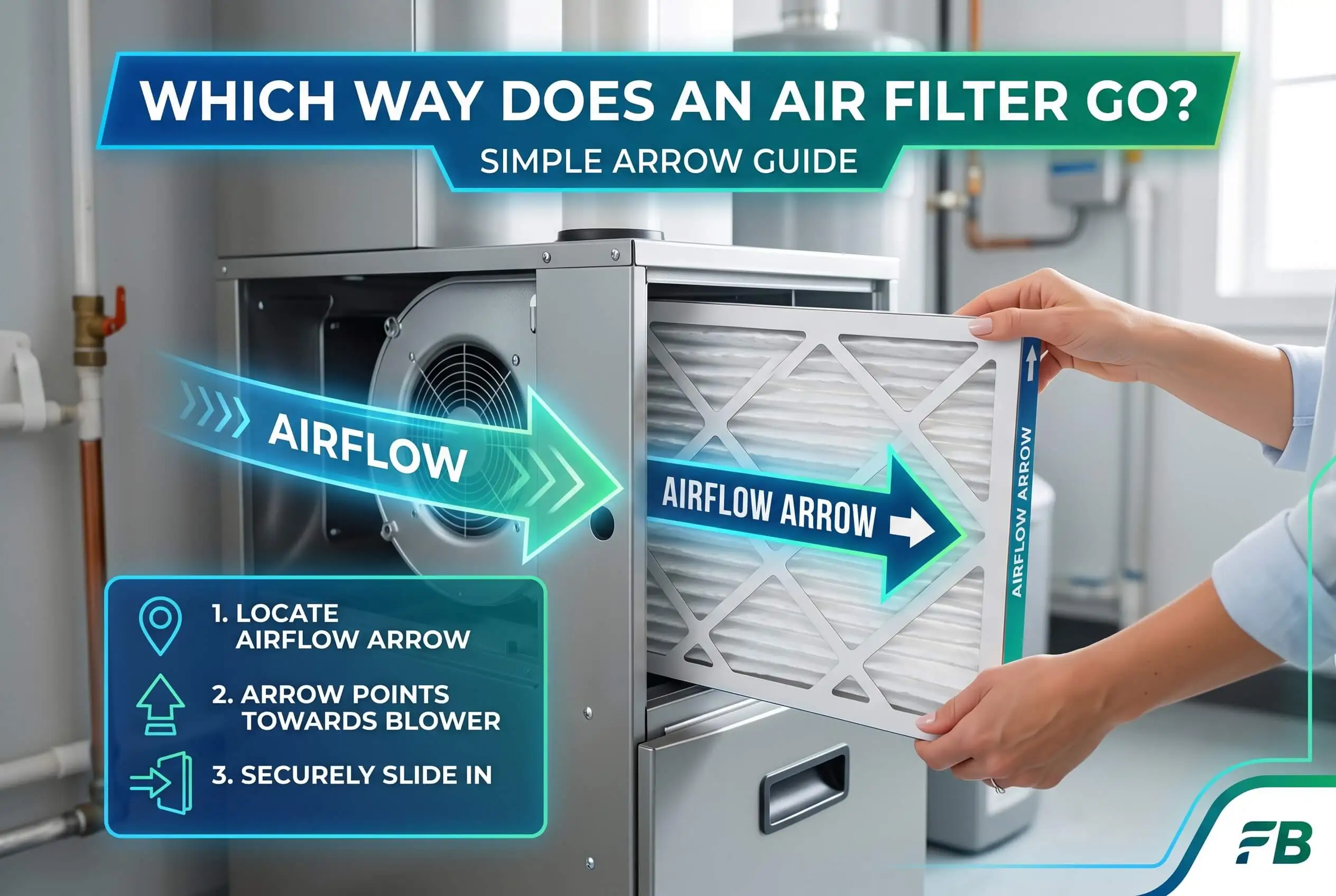
The arrow on the side of the filter points toward the blower motor, which is the direction air flows through your HVAC system. Air moves from the return ducts, through the filter, into the blower, and out through the supply ducts that feed each room of the house.
Upflow furnaces: Arrow points up toward the blower above the filter slot.
Downflow furnaces: Arrow points down toward the blower below the filter slot.
Horizontal furnaces: Arrow points sideways toward the supply duct side of the cabinet.
No arrow visible: Denser side of the filter faces the blower. Looser side faces the return.
Top Takeaways
The arrow on a furnace filter always points toward the blower motor, in the direction air flows through your system.
Upflow units point up, downflow units point down, horizontal units point toward the supply side of the cabinet.
Installing a filter backwards restricts airflow, raises energy use, and strains the blower motor over time.
Filters without arrows still have a correct direction. The denser side goes toward the blower, the looser side toward the return.
Photograph the old filter before removing it. Size, install date, and original arrow direction in a single image.
How to Read the Arrow on Your Furnace Filter
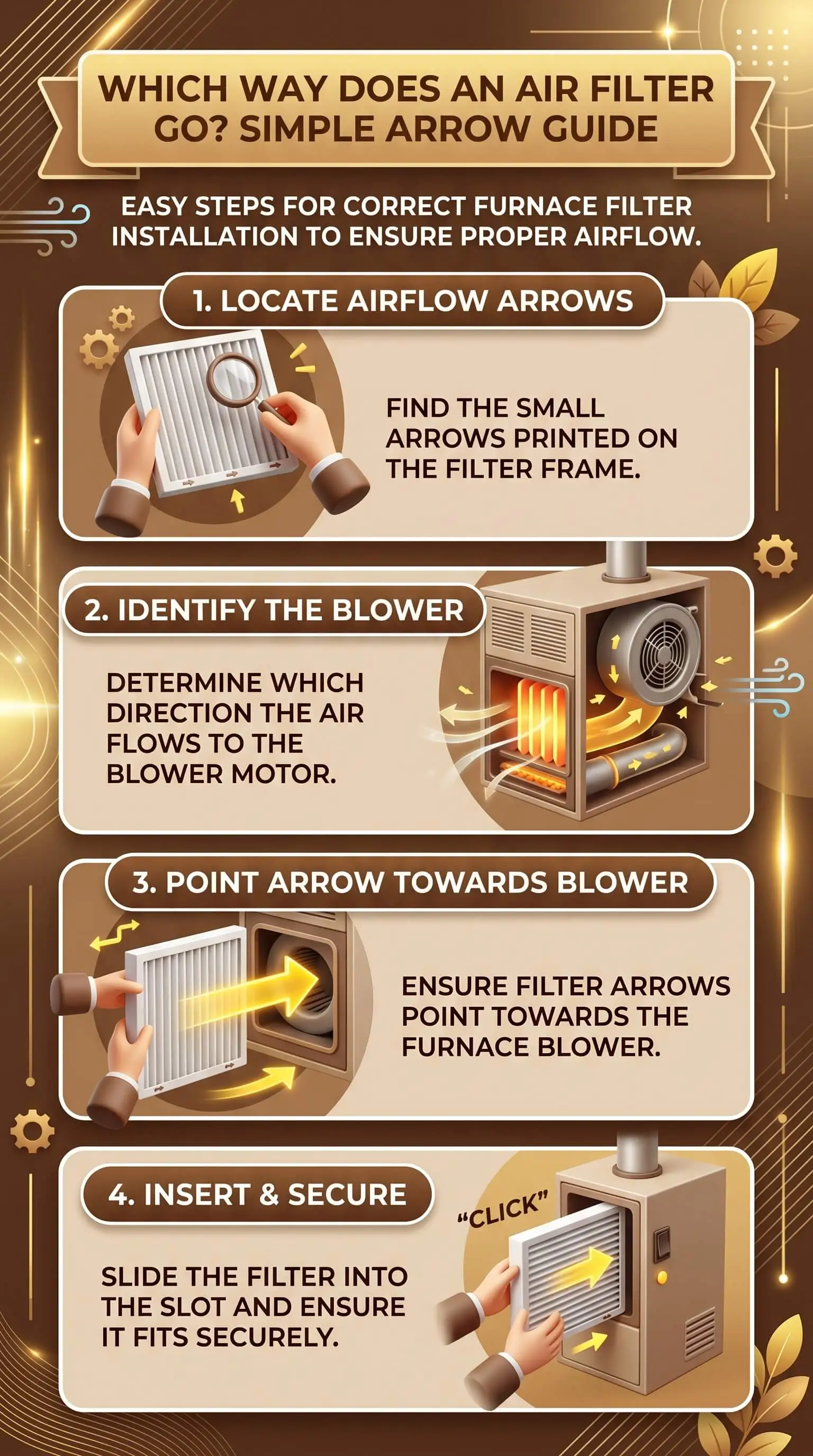
You will find the arrow stamped along the side edge of the cardboard frame, or molded directly into the plastic frame on higher-end filters during furnace filter replacement. That arrow is the key detail to check every time you replace the filter because it points in the direction air travels through your system: from the return ducts, through the filter, into the blower motor, and out through the supply ducts that feed each room of the house.
The memory cue I give homeowners is short. The arrow follows the air. It points toward the fan.
The arrow gets missed for a few reasons on service calls. Mostly it is fade. Older filters and generic store-brand filters print the arrow in low-contrast gray that disappears in a dim utility closet or attic. Sometimes the imprint is covered, either because the homeowner set the filter face-down on a workbench before installation or because a grid mark from the cabinet rail hid the print at exactly the wrong moment. And once or twice a season I will meet a homeowner who saw the arrow clearly and still installed it backwards because they assumed the arrow pointed at the return vent. It does not. The arrow shows where the air goes, not where it comes from.
Arrow Direction by Furnace Type
Three configurations cover almost every residential install I work on.
Upflow units sit in basements, garages, and utility closets. Air comes in from below, passes through the filter, and pushes up through ductwork to the rest of the house. The blower sits above the filter slot, which means the arrow on an upflow filter points up.
Downflow units flip that arrangement. They mount in attics or upstairs closets and push conditioned air down through the floor or ceiling cavity below. The arrow on a downflow filter points down.
Horizontal units lie flat on attic platforms, inside crawl spaces, or in mechanical closets. They are the most common configuration I see in Central Florida homes, where attic platform installs dominate. Air moves sideways through the cabinet, and the arrow points away from the return-side access panel toward the supply plenum at the opposite end.
When the orientation is not obvious from the cabinet layout, find the supply duct. The arrow points toward that side every time.
Step-by-Step Installation
Here is the install sequence I walk every homeowner through:
Switch the system off at the thermostat, and shut off power at the disconnect or breaker if you can locate it.
Find the filter slot. It sits inside the cabinet near the blower on most furnaces, sometimes behind a small access panel marked "filter." On some systems the filter lives behind a wall return grille in the hallway or living area instead.
Pull the old filter out and check two things: the size printed on the frame, and the direction the arrow was pointing. If the previous install was correct, your new filter goes in the same direction.
Confirm the new filter matches the old size exactly. Even a half-inch undersize lets air bypass around the edges, which defeats the whole point of having a filter in line.
Slide the new filter in with the arrow pointing toward the blower. It should fit snug against the slot rails with no visible gap on any side.
Close the access panel and turn the system back on at the thermostat.
One tip I give every homeowner: snap a phone photo of the old filter before you pull it out. That single photo gives you the size, the arrow direction, and the install date if you wrote one on the frame. Three pieces of information in one image, no second-guessing required.
What Happens If You Install a Filter Backwards
A backwards filter does damage in three ways, and the damage is gradual enough that most homeowners never connect the symptoms back to the filter cabinet.
The first problem is airflow restriction. Furnace filter media is layered. The looser, more open side is built to face the return air. The denser side is built to face the blower. Flip the filter and air hits the dense layer first, which pushes static pressure across the filter up and forces the blower to work harder for every cubic foot it moves.
Filtration drops too, because the layered media is engineered to capture progressively smaller particles as the air moves through it. Reversing the direction breaks that capture sequence, which matters whether you call it furnace filter vs air filter in a home HVAC system. Larger debris that should have been caught in the open front layer ends up packed into the dense back layer, which clogs it faster than it would clog if installed correctly.
The blower motor takes the worst of it over time. Higher static pressure means longer run cycles, higher amp draw on every cycle, and more heat retained inside the motor housing. A season or two of that compounded strain shows up in worn motor bearings and a tired capacitor.
What If Your Filter Has No Arrow
Some filters, particularly the cheapest fiberglass throwaway models, do not include directional arrows from the factory. Direction still matters with these filters, because they still use layered media.
Two visual cues will tell you which way to install them. The denser, more tightly woven side goes toward the blower. The looser, more open side faces the return air. Some filters also include a wire mesh backing on one side, which faces the blower.
When in doubt, hold the filter up to a light. The side that lets more light through faces the return. The side that blocks more light faces the blower.
"The mistake I see on Central Florida service calls more than any other is a homeowner who just swapped their own filter and put it in pointing the wrong direction. They are not careless. They were working in a dim attic in August, the arrow on the frame had faded, and nobody ever told them the arrow points toward the fan instead of toward the return air. The fix takes two minutes. But if the filter sits backwards for a whole heating or cooling season, the blower pays for it."
7 Essential Resources
Wikipedia — Air Filter Overview. Background on how particulate air filters work, the materials and pleating designs used in residential filter media, and the standards that govern filtration efficiency ratings.
Filterbuy — Furnace Filter Direction Guide. Visual walkthrough of arrow direction across upflow, downflow, and horizontal furnace configurations, with troubleshooting for unmarked filters.
EPA — Indoor Air Quality (Report on the Environment). Federal data on indoor pollutant concentrations, exposure rates, and the role of mechanical filtration in residential ventilation systems.
DOE Energy Saver — Air Conditioner Maintenance. Department of Energy guidance on filter replacement frequency, airflow obstruction effects on system efficiency, and HVAC coil care.
ENERGY STAR — Heat & Cool Efficiently. Official recommendations on filter replacement intervals, duct sealing, and seasonal HVAC tune-ups for residential systems.
EPA — The Inside Story: A Guide to Indoor Air Quality. Joint EPA and CPSC consumer guide covering pollutant sources, ventilation, and filtration strategies for residential homes.
EIA — Use of Energy in U.S. Homes. Energy Information Administration breakdown of residential energy consumption by end use, including heating and cooling as the largest household expenditure.
3 Statistics
According to the U.S. Environmental Protection Agency, Americans spend approximately 90 percent of their time indoors, where concentrations of some pollutants are often 2 to 5 times higher than outdoor levels. The filter sitting in your furnace cabinet is the mechanical line of defense between those indoor pollutants and the air your family breathes every cycle the system runs.
The U.S. Energy Information Administration reports that 52 percent of an average household's annual energy consumption in 2020 went to just two end uses: space heating and air conditioning. A backwards-installed filter raises the energy cost of every cycle your HVAC system runs, which compounds across an entire heating and cooling season.
The U.S. Department of Energy notes that dirty, clogged, or restricted filters reduce airflow and system efficiency, with the obstruction allowing dirt to bypass the filter and accumulate on the evaporator coil. Filter direction sits inside the same airflow equation, since a reversed filter produces functionally similar restriction at the cabinet.
Final Thoughts and Opinion
The arrow on your furnace filter is the smallest visible decision in your entire HVAC system, and it carries weight far out of proportion to its size. Two minutes of attention at install time saves you from months of higher utility bills and years off the blower motor's working life. My honest opinion, after years of residential service calls: the single most cost-effective habit for maintaining HVAC system performance is photographing the old filter before pulling it out. Size, arrow direction, install date — three answers in one photo, every time.
Frequently Asked Questions
Which way should the arrow face on a furnace filter?
The arrow should face toward the blower motor, which is the direction air flows through your HVAC system. Air moves from the return ducts, through the filter, into the blower, and out through the supply ducts that feed each room. The arrow shows the direction of travel, not the source of the air.
Does it matter which way a furnace filter goes?
Yes. Filter media is layered, with a looser front side and a denser back side. Installing the filter backwards reverses that capture sequence, restricts airflow, and forces the blower to work harder. The damage is gradual but measurable, showing up as higher energy bills and reduced system lifespan over time.
What happens if I install my filter backwards?
Three problems show up, and they compound on each other. Airflow restricts because the dense side of the filter hits the air first. Filtration efficiency drops because the layered media works in the wrong sequence. And the blower motor wears faster because it has to push air against higher static pressure on every cycle the system runs.
How do I tell which way the filter goes if there is no arrow?
Hold the filter up to a light. The side that lets more light through is the return-facing side. The denser, more tightly woven side faces the blower. If the filter has a wire mesh backing on one side, that mesh side faces the blower as well.
Does pleat direction matter on a furnace filter?
No. The pleats can run in any orientation, vertical or horizontal, without affecting performance. Only the airflow arrow matters, because the arrow indicates the direction of the filter media's layered capture design.
Keep a Visual Reference Handy
Bookmark this Filterbuy guide to furnace filter direction before your next filter change, especially when comparing furnace filter cost and making sure the filter you buy fits the system correctly. It walks through arrow placement across upflow, downflow, and horizontal units with diagrams for each configuration.
In an article about Which Way Does an Air Filter Go in a Furnace? Simple Arrow Guide, it’s helpful to connect filter direction with choosing the right replacement filter, because even a correctly sized filter has to be installed with the airflow arrow pointing toward the furnace or blower compartment. Options like 14x20x1 furnace filters, 14x24x1 HVAC air filters, and 12x30x1 furnace filters fit naturally into the topic because homeowners need to confirm both the correct size and the correct arrow direction during installation, helping the furnace maintain cleaner airflow, protect the blower motor, and perform more efficiently after each filter change.